Wineries · · Updated
Essential Wineries to Discover the Wines of Granada
My personal guide to the wineries that best explain the wines of Granada: high-altitude vineyards, small producers and family projects placing the province among the most authentic wine regions in southern Europe.
By Ricardo Martínez, WSET certified sommelier in Granada

To talk about the wines of Granada is to talk about landscape. About mountains. About altitude. About climatic contrasts. About small plots. About a viticulture that is often heroic. And, above all, about people who have decided to make wines with their own identity in one of the most singular territories in Andalusia.
Because Granada is not a uniform wine region. Here, high-mountain vineyards, Mediterranean influence, continental climate, slate soils, extreme high plains and an enormous diversity of microclimates all coexist. And that is precisely where much of the personality of its wines comes from.
For years, many wineries in Granada lived far from the major spotlights of Spanish wine. But that is starting to change. Today there is a new generation of producers helping to position Granada as one of the most interesting and authentic wine territories in southern Europe.
Perhaps the most fascinating thing about Granada is not only the quality of some of its wines, but the sense of authenticity it still preserves.
Here you can still find family wineries, small projects, artisanal viticulture, approachable producers and wines born more from passion than from marketing. And in today's wine landscape, that is enormously valuable.
Altitude as a mark of identity
A large part of the wineries in Granada work at altitudes that are unusual in Europe. Many vineyards sit between 800 and 1,200 metres, and even above 1,300 metres.
This allows for slow ripening, excellent preservation of acidity, fresh wines, complex aromatic profiles and an identity strongly shaped by the land. Altitude has become one of the great differentiating arguments of Granada wine.
This is not about making a ranking. Each project represents a different way of understanding wine and territory. But there are some wineries that are especially interesting for grasping the diversity and potential of the province. The D.O.P. Vinos de Granada itself currently lists some of the most representative ones, and below I share those that, for me, best explain where this wine comes from and where it is heading.
La Contraviesa-Alpujarra and the Costa Tropical
In the south of the province, between the mountains and the Mediterranean, lies one of the areas with the most history and character in Granada wine.
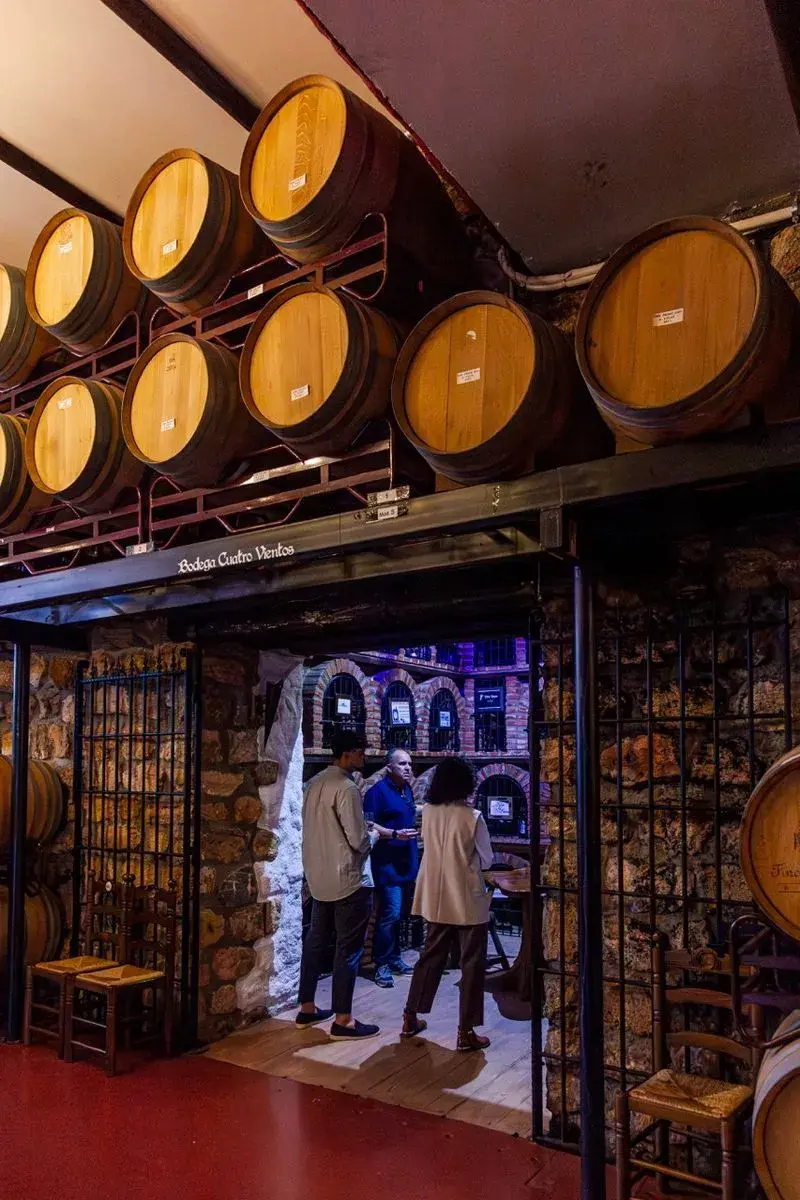
Bodega Cuatro Vientos
A classic of wine tourism in La Contraviesa-Alpujarra. Beyond the wine, it offers an experience closely tied to Alpujarra culture, traditional gastronomy and the natural surroundings. It is one of those places where wine is understood as part of a rural, Mediterranean way of life. You will find it on the Carretera de Murtas, Km 7, 18490 Granada (+34 630 23 62 44).
Restaurante & Bodega Haza del Lino
Located in the heart of La Contraviesa-Alpujarra, it is one of the historic wineries of the province and one of the great references of Granada's high-altitude wine. They farm vineyards at high altitude with a marked Mediterranean influence. It sits on the A-4131 road, Km 16, in Polopos – La Mamola (958 83 68 21). Among its standout wines you will find the Haza del Lino Tinto Crianza, the Haza del Lino Blanco and the Costa Joya.
Bodega Barranco Oscuro
A pioneering project by Manuel Valenzuela and one of the most influential wineries in organic viticulture and natural wines in Andalusia. They craft minimal-intervention wines at high altitude, at the Cortijo Barranco Oscuro, in Cádiar. If you want to understand the natural wines of the south, this is an essential starting point: try its Brut Nature, the Rubaiyat, the Trance or the Vino Costa.
Bodegas La Divisa
One of the most singular and promising projects of the new Granada scene. They farm organic, vegan vineyards above 1,300 metres of altitude in the heart of the Sierra de la Contraviesa, with singular plots, slate soils and mineral, saline profiles influenced by the nearby Mediterranean.
They probably represent very well where part of contemporary wine is heading: less artifice and more landscape.
Their wines pursue minimal intervention, expression of terroir and authenticity. Among the highlights, La Divisa Vigiriego, the Garnacha de Altura and their organic single-plot wines.
Bodegas Nazaríes
A small family project focused on wines with Mediterranean character and a strong sense of place, at the Cortijo Los Amates, in Albuñol (680 91 29 28). Look for its Nazaríes Tinto and the Nazaríes Barrica.
Bodega García de Verdevique
An artisanal project deeply tied to traditional Alpujarra agriculture and to a way of making wine that respects its surroundings, at the Cortijo Los García de Verdevique (958 95 70 25). Here you will find mountain reds and limited, artisanal productions.
Señorío de Nevada
Probably one of the best-known and most recognisable wineries in Granada. Set between Sierra Nevada and the Valle de Lecrín, it combines spectacular scenery, integrated architecture, a wine hotel and a very approachable offering for anyone wanting to get started with Granada wine. Its wines tend to show modern, balanced profiles, very much geared towards gastronomy. It has also played an important role in raising the profile of wine tourism in the province.
Bodegas Calvente
Highly regarded, especially for its white wines and its work with aromatic varieties on the Costa Tropical. You will find it on C. Viñilla, 8, in Jete (958 64 41 79). Its whites are a small gem: the Calvente Blanco, its moscateles and its Chardonnay.
The high plains, the Geopark and the Guadix area
Heading north and east, the wine of Granada turns continental, extreme and deeply mineral.
Bodegas Anchurón
One of the most interesting projects in terms of territorial identity and sustainability. The estate works exclusively with its own grapes and is committed to a limited, tightly controlled production, incorporating renewable energy into the winemaking process. Its wines reflect the personality of the Granada high plains very well: thermal range, slow ripening and structured yet fresh profiles. It is located at the Cortijo El Anchurón, in Darro (675 37 95 34). Don't miss its Anchurón Crianza, Reserva, Blanco and Rosado.
Bodegas Muñana
Situated at around 1,200 metres of altitude, it is one of the wineries most closely tied to the concept of high-altitude wine and nature. Its setting, near the Granada Geopark and Sierra Nevada, makes a visit especially appealing in scenic and wine-tourism terms. It also runs complementary activities such as trails, nature experiences, cave visits and active tourism. A very interesting way of understanding wine as a territorial experience.
Bodegas Pérez Soto
A family project with decades of tradition in the Granada high plains, on the Almería road, 41, in Exfiliana (958 69 80 36). It represents very well that less visible side of Granada wine, more tied to the land and to the continuity of small family structures that keep wine culture alive in many rural areas.
Bodegas Vertijana
One of the most interesting wineries for sparkling wines and high-altitude organic wines in Granada. You will find it on the P.º Sierra Nevada, 18, ground floor, in Polícar (685 58 78 85). Try its Vertijana Espumoso Brut Nature, the Vertijana Rosado and the Tempranillo Crianza.
Bodegas al Zagal
A modern winery located in Cogollos de Guadix, with structured red wines and good fruit expression, at the Paraje Las Cañaillas (958 10 56 05). Among its references, the Al Zagal Crianza, the Al Zagal Reserva and its young whites.
Bodega Toral
A small family winery focused on high-altitude wines made in an artisanal way, on C. Arboleda, in Graena (614 29 44 28). Here you will find signature reds and limited editions.
Bodega Cerro de las Cruces
A young project with modern wines and a marked mineral expression of the Granada high plains, on the Benalúa road, opposite the Centro de Espiritualidad, in Guadix (630 75 23 43). Look for its Cerro de las Cruces Roble and its Crianza.
Bodega Pago de Almaraes
A modern winery in the Granada Geopark, in Benalúa de Guadix, focused on elegant, expressive wines. Its Pago de Almaraes Crianza and its special selections stand out.
Bodegas Méndez Moya
A traditional family project from Guadix, historically linked to local winemaking and to the marketing of the area's wines. Traditional reds and young wines that tell the story of Granada's classic wine heritage.
Bodegas Fontedei
A winery well known for its approachable wines and its broad commercial presence inside and outside Andalusia, on Calle Dr. Horcajadas, 10, in Deifontes (958 40 79 57). Its range includes the Fontedei Crianza, the Fontedei Roble, young whites and sparkling wines.
The north of Granada: Huéscar, Galera, Baza and Caniles
The far north of the province, deep in the high plains, holds some of the most artisanal and exciting projects in all of Granada.
Bodega Fernández Herrero
A family winery tied to the agricultural tradition of northern Granada, at the Cortijo El Duque (A-4301), in Huéscar (647 78 53 67). Young reds and artisanal productions that breathe tradition.
Bodegas Carayol & Castellar
A very interesting boutique project from northern Granada, with a philosophy of minimal intervention and small productions, on C. Jardines, 9, in Galera (686 21 82 53). Its single-plot wines, high-altitude grenaches and signature reds are well worth seeking out.
Bodegas Jaraiz
A traditional project from northern Granada, in Galera, historically linked to local cultivation and small-scale winemaking. Traditional wines of the area that keep the character of the high plains alive.
Bodegas Vilaplana
A family project focused on honest, minimal-intervention viticulture in the Granada high plains, at Las Molineras, 23, in Caniles (639 72 90 37). It has a range full of personality: Zimbra, Impía, Paraje del Mincal, Dos Flamencos and Diez Días de Marzo.
Bodega Los Barrancos
A small, artisanal project tied to local agricultural tradition, one of those discreet productions that so well represent the most intimate side of Granada wine.
The importance of small wineries
One of the most interesting aspects of Granada wine is that much of its current identity is born precisely from small projects. Wineries where the producer is still present, where human scale still matters and where the connection between vineyard and bottle is far more direct.
This allows them to work with more sensitivity, more creative freedom and a much more honest relationship with the land.
Granada and the future of wine tourism
Granada has enormous potential to develop a different model of wine tourism. One based not only on large infrastructures or conventional luxury, but on authenticity, landscape, gastronomy, sustainability and more human experiences. And that very trend is growing enormously in today's gastronomic tourism.
Visitors increasingly want to meet the producer, walk among the vineyards, understand the land and live real experiences. And in that, Granada holds an enormous advantage.
Granada wine still has soul
Perhaps the most beautiful part of discovering these wineries is not only tasting their wines, but understanding the stories behind them: families, personal projects, the recovery of old vineyards, mountain agriculture and people who work from passion and respect for the land.
Because in the end, the most interesting wines are not always the most famous ones. Very often they are the ones that manage to convey honesty, landscape and emotion within a single glass.
And Granada still preserves a great deal of that. If you would like to discover some of these wineries through private visits, tastings or personalised wine-tourism experiences in Granada and Andalusia, you can find more information at RicardoMartinez.es.